
Medically Reviewed by Dr Nehal Dhaduk — MBBS, DNB – Obstetrics & Gynecology, Atharva Gynae Clinic, Sector 10A, Gurgaon
When a hysterectomy is recommended, one of the most important decisions is how the uterus should be removed. Depending on the patient's medical condition, a hysterectomy may be performed through minimally invasive surgery, such as laparoscopic hysterectomy, or through an open abdominal procedure.
So, when comparing Laparoscopic Hysterectomy vs Open Surgery, which is better?
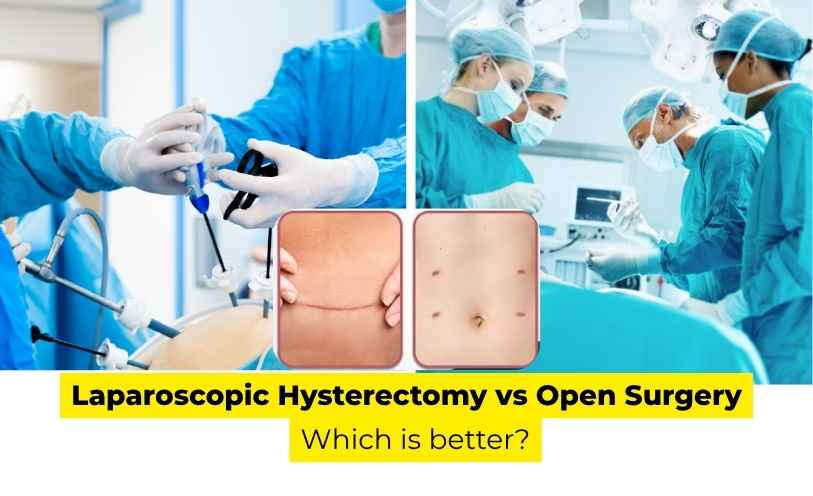
For many women who are suitable candidates, laparoscopic hysterectomy offers important advantages such as smaller incisions, less postoperative pain, shorter hospital stays and faster recovery compared with open abdominal hysterectomy. However, open surgery may be safer or more appropriate in certain situations, such as a very large uterus, extensive adhesions, complex pelvic disease or specific cancer-related surgical requirements.
The best approach is therefore not simply the one that is "less invasive." It is the approach that can safely and effectively treat the underlying condition while minimizing risks for the individual patient.
What Is a Hysterectomy?
A hysterectomy is a surgical procedure to remove the uterus. Depending on the patient's condition, the cervix, fallopian tubes and ovaries may or may not also be removed.
Hysterectomy may be recommended for conditions such as:
- Large or symptomatic uterine fibroids
- Abnormal or heavy uterine bleeding
- Endometriosis
- Adenomyosis
- Uterine prolapse
- Chronic pelvic pain in selected cases
- Certain precancerous or cancerous conditions
A hysterectomy permanently ends the ability to become pregnant. Whether the ovaries are removed is a separate decision and depends on factors including age, medical indication, ovarian health and cancer risk.
ACOG notes that hysterectomy can be performed through the vagina, laparoscopically or through an abdominal incision, with the choice depending on the patient's condition and surgical factors.
What Is Laparoscopic Hysterectomy?
Laparoscopic hysterectomy is a minimally invasive approach in which the surgeon operates through several small abdominal incisions rather than one large abdominal incision.
A thin camera called a laparoscope is inserted through one of the small incisions. Surgical instruments are introduced through additional small openings, allowing the surgeon to operate on the uterus and surrounding pelvic structures while viewing the surgical field on a monitor.
Depending on the surgical technique, the uterus may be removed through the vagina or through one of the abdominal openings after being appropriately prepared for removal.
Because the incisions are considerably smaller than those used for open abdominal surgery, laparoscopic hysterectomy generally results in less postoperative pain, smaller scars and a faster recovery when compared with open abdominal hysterectomy.
What Is Open Abdominal Hysterectomy?
An open hysterectomy, also called an abdominal hysterectomy, involves removing the uterus through a larger incision in the lower abdomen.
The larger surgical opening gives the surgeon direct access and a broad view of the pelvic organs. This can be particularly useful when the anatomy is complex or when a minimally invasive approach is not considered safe or practical.
Open surgery remains an important option for selected patients even though minimally invasive surgery is preferred whenever it can be performed safely and appropriately.
Laparoscopic Hysterectomy vs Open Surgery: Key Differences
| Factor | Laparoscopic Hysterectomy | Open Abdominal Hysterectomy |
|---|---|---|
| Incisions | Several small incisions | One larger abdominal incision |
| Pain after surgery | Usually less | Usually more |
| Scarring | Smaller scars | Larger scar |
| Hospital stay | Generally shorter | Generally longer |
| Recovery | Usually faster | Usually slower |
| Wound complications | Generally lower | Generally higher |
| Return to normal activities | Usually sooner | Usually later |
| Surgical access | Excellent visualization through camera | Wide direct access |
| Very large uterus / complex disease | May not always be suitable | May be preferred in selected cases |
| Conversion to open surgery | Possible in difficult cases | Not applicable |
ACOG states that laparoscopic hysterectomy generally has advantages over abdominal hysterectomy, including less pain, lower infection risk, shorter hospitalization and earlier return to normal activities. Abdominal hysterectomy, however, may be useful when the uterus is very large or significant adhesions are present.
Benefits of Laparoscopic Hysterectomy
When a patient is an appropriate candidate, laparoscopic hysterectomy can provide several potential benefits.
1. Smaller Incisions
Instead of a large abdominal incision, laparoscopic surgery uses small openings for the camera and instruments. This generally means smaller scars and less disruption to the abdominal wall.
2. Less Postoperative Pain
Because the abdominal incisions are smaller, patients typically experience less postoperative pain compared with open abdominal surgery. Pain levels still vary from person to person and depend on the complexity of the procedure and individual healing.
3. Shorter Hospital Stay
Many patients undergoing minimally invasive hysterectomy can leave the hospital sooner than patients undergoing open abdominal hysterectomy. The exact duration depends on the procedure, medical history, hospital protocols and recovery after surgery.
4. Faster Recovery
One of the biggest advantages of minimally invasive surgery is the potential for an earlier return to normal daily activities. ACOG identifies faster recovery and shorter hospitalization as established advantages of minimally invasive hysterectomy compared with abdominal hysterectomy.
5. Lower Risk of Some Wound Complications
The smaller incisions used during laparoscopy can reduce the risk of certain wound-related complications compared with a large abdominal incision. However, laparoscopic surgery is still major surgery and can have significant complications.
When May Open Hysterectomy Be a Better Choice?
Laparoscopic surgery is not automatically the right option for every patient. An open abdominal hysterectomy may be considered when:
- The uterus is extremely large
- There are extensive pelvic adhesions
- There is significant endometriosis or complex pelvic disease
- The anatomy makes minimally invasive surgery technically difficult
- There is a suspected or confirmed cancer requiring a particular surgical approach
- Significant bleeding or another complication requires conversion to open surgery
- The surgeon determines that open access provides the safest way to complete the operation
ACOG emphasizes that the route of hysterectomy should be selected according to factors such as uterine size, pelvic anatomy, adhesions, extrauterine disease, concurrent procedures, surgeon experience and available surgical resources.
Therefore, open surgery should not be considered an inferior procedure. In selected situations, it may provide the safest and most appropriate surgical access.
Is Laparoscopic Hysterectomy Always Better Than Open Surgery?
No. This is one of the most important points patients should understand.
Laparoscopic hysterectomy has several advantages for appropriately selected patients, but the safest surgical approach depends on the individual clinical situation.
For benign gynecological conditions, ACOG considers minimally invasive approaches preferable whenever feasible, and specifically identifies laparoscopic hysterectomy as a preferable alternative to open abdominal hysterectomy when vaginal hysterectomy is not appropriate or possible.
However, if minimally invasive surgery cannot safely accomplish the procedure, an open hysterectomy may be the better choice.
The goal is not to choose the smallest incision at any cost. The goal is to achieve the safest and most effective treatment.
Laparoscopic Hysterectomy Recovery vs Open Surgery Recovery
Recovery varies significantly between individuals, but there is generally a difference between the two approaches.
After Laparoscopic Hysterectomy
Patients may experience:
- Mild to moderate abdominal discomfort
- Temporary bloating
- Fatigue
- Shoulder-tip discomfort caused by the gas used during laparoscopy
- Vaginal discharge or light bleeding
- Gradual improvement in mobility and energy
Because the incisions are small, many patients can resume routine activities sooner than after open surgery.
After Open Hysterectomy
Recovery may involve:
- More abdominal discomfort
- Greater restriction on physical activity initially
- Longer wound healing
- A larger abdominal scar
- A longer overall recovery period
The exact recovery timeline should always be discussed with the operating gynaecologist because it depends on the surgical procedure, patient's health, complications and type of work or physical activity.
Are There Risks With Laparoscopic Hysterectomy?
Yes. Laparoscopic surgery is minimally invasive, but it is still a major surgical procedure. Potential complications can include:
- Bleeding
- Infection
- Blood clots
- Injury to the bladder
- Injury to the ureters
- Bowel or blood-vessel injury
- Anaesthesia-related complications
- Incisional hernia
- Need to convert to open surgery
ACOG also notes that laparoscopic hysterectomy can carry a risk of injury to the urinary tract and nearby organs, and in some cases a procedure that begins laparoscopically may need to be converted to open surgery.
The surgeon should discuss these risks and the possibility of conversion before surgery.
How Does a Gynaecologist Decide Which Hysterectomy Is Best?
A gynaecologist in Sector 10 Gurgaon or elsewhere will generally consider several factors before recommending the surgical route. These may include:
1. Reason for Hysterectomy
The underlying diagnosis is one of the most important considerations. Fibroids, endometriosis, adenomyosis, prolapse and cancer can require different surgical strategies.
2. Size of the Uterus
A very large uterus may make minimally invasive surgery more technically challenging.
3. Previous Abdominal Surgeries
Previous operations can result in adhesions that may make laparoscopic surgery more complex.
4. Pelvic Anatomy
The accessibility of the uterus and surrounding structures can influence the safest surgical approach.
5. Other Conditions Being Treated
If additional procedures are required during the same operation, the surgical plan may change.
6. Overall Health
Medical conditions, anaesthesia risks and previous surgical history all need to be considered.
7. Surgeon's Experience
The surgeon's training and experience with minimally invasive procedures are important factors in selecting the safest approach. ACOG specifically includes surgeon training and experience among the factors that influence the route of hysterectomy.
What Questions Should You Ask Before a Hysterectomy?
Before undergoing surgery, consider asking your gynaecologist:
- Why do I need a hysterectomy?
- Is laparoscopic hysterectomy suitable for my condition?
- Could an open hysterectomy be safer in my case?
- What will happen to my ovaries and fallopian tubes?
- What type of hysterectomy are you recommending?
- How long is the expected recovery?
- What are the possible complications?
- Could the procedure need to be converted from laparoscopic to open surgery?
- What restrictions will I have after surgery?
- Are there non-surgical or less invasive alternatives in my situation?
A detailed discussion helps ensure that the decision is based on your medical needs rather than simply choosing one surgical method over another.
Laparoscopic Hysterectomy vs Open Surgery: Which Is Better for You?
If both approaches are medically feasible, laparoscopic hysterectomy is generally preferred over open abdominal hysterectomy because it usually offers smaller incisions, less postoperative pain, shorter hospitalization and faster recovery.
However, this does not mean laparoscopic surgery is appropriate for everyone. For patients with a very large uterus, extensive adhesions, complex pelvic disease or certain cancer-related requirements, open surgery may provide better or safer access.
Therefore, the answer to "Laparoscopic Hysterectomy vs Open Surgery: Which Is Better?" is:
Laparoscopic hysterectomy is often the preferred option when it can be performed safely, but the best approach is the one that provides the safest and most effective treatment for the individual patient.
If you are considering hysterectomy, consult an experienced gynaecologist who can assess your diagnosis, imaging, medical history and surgical requirements before recommending the appropriate approach.
Choosing a Gynaecologist in Sector 10 Gurgaon
If you are looking for a Gynaecologist in Sector 10 Gurgaon for evaluation of fibroids, abnormal uterine bleeding, endometriosis or other conditions that may require hysterectomy, an individualized consultation is important.
At Atharva Gynae Clinic, Sector 10A, Gurgaon, Dr Nehal Dhaduk, MBBS, DNB – Obstetrics & Gynecology, provides evaluation and management of women's health and gynaecological conditions.
For patients who may require minimally invasive surgery, discussing the procedure with an experienced Laparoscopic Surgeon in Gurgaon can help determine whether laparoscopic hysterectomy is appropriate.
Frequently Asked Questions
Is laparoscopic hysterectomy safer than open surgery?
For appropriately selected patients, laparoscopic hysterectomy generally has advantages such as smaller incisions, less postoperative pain, shorter hospitalisation and faster recovery. However, no surgical approach is risk-free, and open surgery may be safer for certain complex cases.
How long does it take to recover from laparoscopic hysterectomy?
Recovery varies from patient to patient. In general, recovery after laparoscopic hysterectomy is faster than after open abdominal hysterectomy, but the exact timeline depends on the complexity of surgery and individual health.
Does laparoscopic hysterectomy leave scars?
Yes. Laparoscopic hysterectomy requires small abdominal incisions, which leave small scars. These are generally smaller than the scar associated with open abdominal hysterectomy.
Can a laparoscopic hysterectomy be converted to open surgery?
Yes. Occasionally, the surgeon may need to convert a laparoscopic procedure to an open operation if unexpected anatomy, extensive adhesions, bleeding, suspected cancer or another surgical issue makes open access safer.
Is open hysterectomy better for a large uterus?
Not necessarily in every case. A large uterus can make laparoscopic surgery more technically challenging, but the decision depends on uterine size, anatomy, surgeon expertise and other clinical factors.
Does hysterectomy remove the ovaries?
Not necessarily. Removing the uterus and removing the ovaries are separate decisions. Depending on the patient's age, condition and cancer risk, the ovaries may be preserved.
Will I enter menopause after hysterectomy?
If the ovaries are retained, hysterectomy itself does not automatically cause immediate menopause. If both ovaries are removed before natural menopause, surgical menopause occurs because ovarian hormone production drops abruptly.
Can I avoid hysterectomy?
Sometimes. Treatment depends on the underlying condition. Depending on the diagnosis, alternatives may include medication, hormonal treatment, minimally invasive procedures or observation. Your gynaecologist can explain which options are appropriate for you.
Key Takeaway
Laparoscopic Hysterectomy vs Open Surgery is not a simple "better versus worse" decision.
For many suitable patients, laparoscopic hysterectomy provides the benefits of minimally invasive surgery, including smaller incisions, less pain, shorter hospitalisation and faster recovery. However, open hysterectomy remains an important and sometimes necessary option for complex cases.
The right surgical approach should be decided after a detailed evaluation by an experienced gynaecologist and laparoscopic surgeon.
Medical Disclaimer: This article is intended for general educational purposes and should not replace an individual consultation with a qualified medical professional. The appropriate type of hysterectomy depends on the patient's diagnosis, medical history, examination findings, imaging and surgical assessment.

Dr Nehal Dhaduk
Qualification: MBBS, DNB - Obstetrics & Gynecology
Specialization: Gynecologist, Obstetrician, Reproductive Endocrinologist (Infertility)
Designation: Consultant
Clinic: Atharva Clinic, Sector 10A, Gurgaon
Dr Nehal Dhaduk is an evidence-based women's healthcare provider with special interest in pregnancy care, menopause management, infertility, and women's health. Her clinical approach focuses on accurate diagnosis and patient education.
